
From Sketch to Factory: The 10 Essential Steps to Manufacturing a Custom Bag

Threadworks
Most people who set out to make a bag start by drawing one. That is usually the reason the first sample comes back wrong, arrives late, and costs more than the plan allowed.
A bag is a manufactured object before it is a designed one. The order of operations matters, and most of what slows a product on its way to market comes from doing the right step at the wrong moment.
The sequence below is the same whether you are making a hiking backpack, a travel duffel, a carry-on roller or a work briefcase. The details change, the order does not. This is the one we use at Threadworks, from a first conversation to a bag coming off the line.
Step 1: Write the brief before you sketch anything
The brief is not a mood. It is a set of constraints, and every one of them changes the drawing.
Four things have to be on paper before a pencil moves. Who carries this bag and what do they put in it. What it has to survive, because a daily commute and a two week trip are different engineering problems. What it sells for, since retail price works backwards into a factory cost you either can or cannot hit. And how many you intend to make, which quietly decides which materials and which factories are available to you at all.
Get these wrong and you will discover it at sampling, when changing your mind costs weeks instead of minutes.
Step 2: Take apart the bags you admire, and the ones you don’t
Buy the three bags closest to what you are trying to make and open them up. Cut the lining. Look at how the shoulder strap anchors into the body, how many layers meet at that seam, whether the binding is folded once or twice.
This teaches you more in an afternoon than a month of looking at product photography. It also tells you what a construction actually costs. A bag that feels twice as expensive as its competitor often differs by three or four decisions, not thirty, and you can usually see which ones once the thing is in pieces on a table.
Keep the teardowns. They become reference for the factory later, and pointing at a physical sample removes more ambiguity than any drawing.
Step 4: Sketch broad, then funnel down
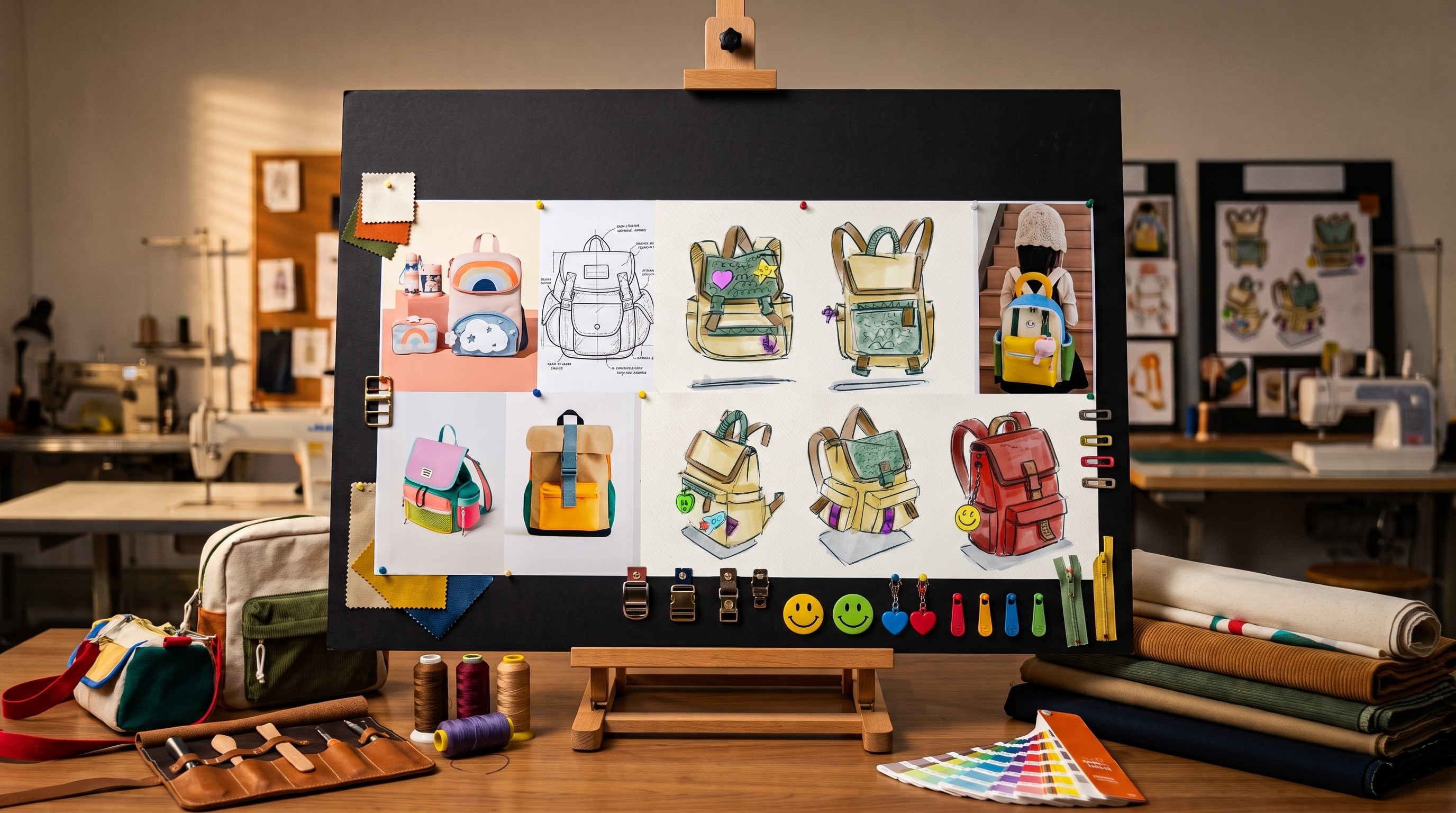
Start wide. Draw the options you are fairly sure you will reject, because the useful ones often sit next to them.
The sketch should carry the intention, not just the outline. A bag meant to be loose, to move and adapt to what the wearer has on, has to be drawn that way. A bag meant to hold its shape whether it is full or empty is a different drawing entirely. That attitude is decided here, in a few lines, long before anyone is arguing about panel dimensions, and if it is not in the sketch it will not be in the bag.
Quick sketches carry most of this work. They are fast enough that you are willing to throw them away, which is the entire point. We bring in 3D only when a specific detail needs resolving, a volume that is hard to judge by eye, a panel intersection that has to be proven before anyone cuts fabric. Modelling everything in 3D early feels productive and mostly slows you down, because it makes each option expensive enough that you stop generating them.
As you go, funnel. Each round removes options rather than adding them, until what remains is the bag.
Step 5: Choose materials with your order quantity in mind
This is where most first time projects quietly go wrong.
Every fabric has a minimum order quantity, and it does not care about your plans. Minimums usually sit around 500 to 600 yards per colour. If the fabric you want has been discontinued and has to be woven again from greige, meaning fabric that has been woven but not yet dyed or finished, you are looking at something closer to 10,000 yards. That is a different business entirely, and it is the kind of thing worth finding out before it appears in a drawing.
Working within those minimums is not a compromise. Proven fabrics are proven for a reason. Recycled X-Pac, Cordura, and a strong 420D ripstop for a hard-wearing base all have known performance, known availability and known pricing. The creative work goes into how they are combined, not into inventing a new cloth.
Ask three questions of every material: what is the minimum order, what is the lead time, and has this factory sewn it before. The third one matters more than people expect. A fabric the factory has never handled will cost you sampling rounds.
Step 6: Match the hardware to the kind of bag you are making
Buckles, zippers, sliders, cord locks, D rings. Together they are often a larger share of the bill of materials than the fabric, and they are almost always the longest lead time item in the bag.
Hardware also has to agree with what the bag is. A fashion-led bag can carry lighter, prettier, more trend-driven trims, and an oversized load-bearing buckle on it looks like it was borrowed from another product. A highly functional bag needs heavy duty hardware that survives being hauled on when the bag is full, and delicate trims on it read as a promise the bag cannot keep. Choose the family first, then the individual pieces.
Do not underestimate this as a selling point. Bag-heads are extremely knowledgeable about hardware and know the brands by name. For that audience the hardware is part of the specification they are buying, not a detail they discover later, and getting it right is something they will notice and pay for.
Custom moulded hardware means tooling, which means money up front and several weeks before you see a first shot. The question is less about hitting a magic unit count than about leverage. Can you use the same piece across several styles in your range? Are you committed enough to a high-end position that hardware carrying your own mark is part of the point? If neither is true, choose well from what already exists and finish it distinctively.


Need bags?
Drop us a message
